
Instruments in Wayne County Deed Records
Deeds are only the start. The Wayne County Clerk's Document Inquiry is billed as a broad county database. It reaches beyond deeds to other recorded documents. Its document-type menu is not published. So treat these labels as families to ask about at the counter. They are not a confirmed portal list. A deed of trust, lien, easement, plat, or release can affect a parcel. None of them ever functions as a sale deed.
| Deed Type | What It Does | Common Use |
|---|---|---|
| Warranty or quitclaim deed | Transfers the interest described in the instrument | Sale, family transfer, or title cleanup |
| Trustee or estate deed | Shows a transfer signed by a fiduciary | Trust or probate property |
| Deed of trust or mortgage | Records a secured loan interest | Financing tied to land |
| Release or satisfaction | Shows a later release of a recorded claim | Loan or lien follow-up |
| Plat, easement, or right-of-way | Maps lots or records a land-use right | Subdivision, access, or boundary context |
Read the instrument label and its legal description together, because the label controls what the document does. A lien is not an ownership transfer. A release wipes out only the claim it names, and a plat maps the lot framework without replacing the recorded document itself. The index is a path, not a title exam.
Wayne County Clerk Index Access
The County Clerk's official page promotes a Document Inquiry service. It covers deeds, marriage licenses, tax information, and other records. The search endpoint does not reliably load. That leaves its start year, image rules, copy prices, and exact field labels unclear. A blank result can simply mean a spelling slip. It can also mean a date outside the index, or a portal outage. It does not prove no transfer was ever recorded.
Before searching online, collect the owner spelling, a likely recording window, the parcel ID, and the legal description. A book and page citation from an assessment card helps. If the interface stays down, the Clerk can run the search at the courthouse. Staff can handle it too. The office lists phone 304-272-6362 and fax 304-272-5318, with mail to P.O. Box 248, Wayne, WV 25570. Hours run Monday-Wednesday and Friday 8 a.m.-4 p.m., Thursday 8 a.m.-6 p.m.
The Document Inquiry link is the advertised online entry point. When it fails, the County Clerk contact page is the practical fallback.
Trace Wayne County Grantors and Grantees
Every deed has two key parties. The grantor transfers an interest in the land, and the grantee takes it. The Clerk's index start year is not published. Reverse-search controls on the index are also undocumented. So a chain must be built by hand from the newest recorded deed, following each named grantee back as a prior owner of record. Record the date, parties, legal description, and book and page for every deed in sequence.
- Locate the latest deed for the current owner, using the parcel or legal description to check that it covers the same land.
- Write down grantor, grantee, recording date, deed type, book/page, and the full legal description.
- Search the prior grantor as a grantee to find the instrument by which that party acquired the parcel.
- Repeat backward; when the online search stops, ask the Clerk for the book index or earlier image source.
- Grantor
- The party transferring the recorded interest.
- Grantee
- The party receiving the recorded interest.
- Chain of title
- The ordered series of transfers for the same land.
- Book/page
- A volume and page citation; ask whether the Clerk also uses an instrument number.
Wayne County Deed Research Before Statehood
Wayne County was formed in 1842 from western Virginia and joined the new state of West Virginia in 1863. Land records reach back nearly that far. FamilySearch catalogs Wayne law-order books covering 1843 through 1859 as microfilm of courthouse originals. Those are court books, not deeds. They still show the older public-record setting. They also point to where the original volumes live.
FamilySearch also offers a West Virginia Wills and Deeds collection spanning multiple counties from the 1700s through 2017. Its images vary by account access. Use both as finding aids, then confirm any land transfer against a Wayne County Clerk deed or a State Archives image. The Wayne County law-order-book catalog describes the 1843-1859 microfilm.
It is a finding aid, not the recorded deed.
Wayne County Deed Books in Preservation
The West Virginia Statewide Preservation Project lists Wayne County as completed for deed-book digitization. The program images county deed books at the State Archives, returns the volumes, and supplies the images for preservation. Its county listing stops short of details. Wayne's exact book and year inventory is not spelled out, so ask before treating the listing as complete online coverage.
Deeper chains need a plan. Ask the Clerk which grantor and grantee volumes cover the transfer date in question. Then search two sources. The State Archives project and FamilySearch both answer to party spelling and land description. The online index's first year is not published. So one web result should never stand in for the county's full historical span. The Statewide Preservation Project listing provides Wayne's completed status.
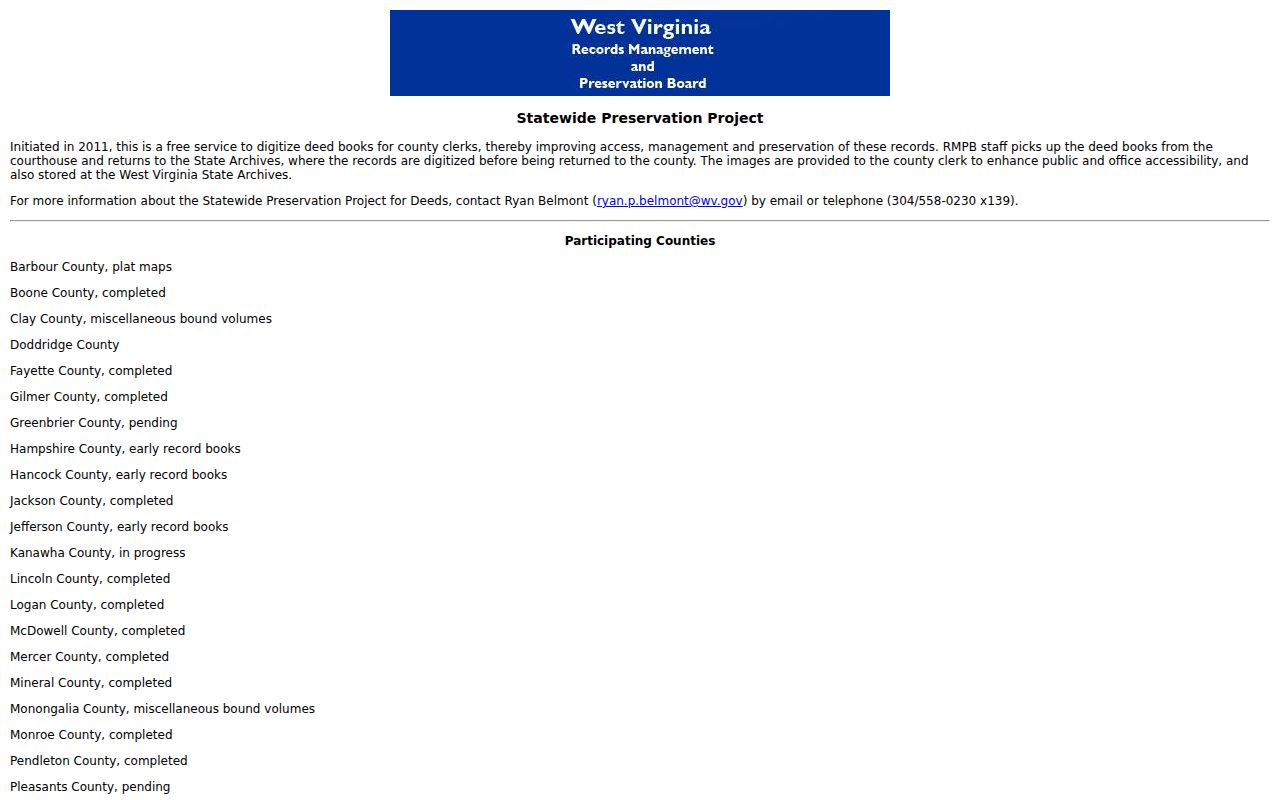
It aids the search without naming Wayne deed books.
Wayne Courthouse Fire and Deed Searches
Fire shaped Wayne County's record history. Historical accounts describe a 1921 courthouse fire during the county-seat conflict, along with a 1905 town fire. Those events complicate old deed searches. The State Archives helps here. Courthouse histories are useful stops as well, though no official finding aid identifies which deed books or indexes were lost or rebuilt. Claiming a specific gap needs proof.
When two deeds fail to form a clean chain, note the dates and citations on both sides of the break. Ask the Clerk whether a volume is missing, renumbered, or preserved on a separate image series. Check probate, court, and tax-deed paths too. A history clue can point the question, but only the instrument inventory can answer it. The e-WV Wayne courthouse history supplies the local context.
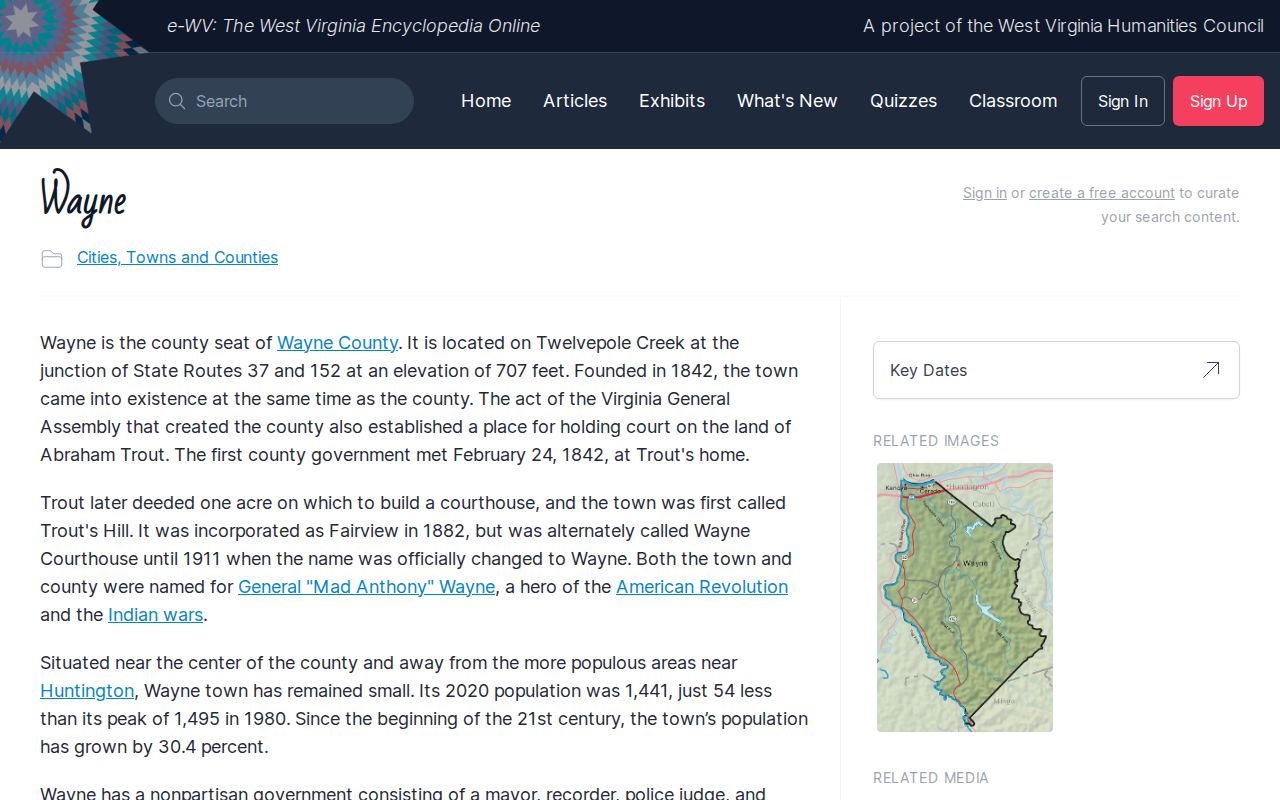
The image gives a history lead only; it does not identify a deed-book loss.
Wayne County Court Dockets as Deed Leads
Court dockets can lead you straight to a deed. In Wayne County, foreclosure, partition, quiet-title, and lien disputes all generate circuit-court filings tied to land. WVPASS publishes circuit documents going back to 1999. Its 2025 launch notice describes free registration plus a small charge for each document download. The Magistrate Record Search costs nothing. It returns up to 30 name or case-number matches, though the underlying papers sit with the county clerk rather than online.
Remember what a docket is. It locates a case, not recorded ownership. When a judgment, sale, or release touches a tract, confirm that an instrument was actually recorded with the County Clerk and match its legal description. The magistrate side may display a document list and a disposition, but it does not hand you the papers. So treat Magistrate Record Search as a lead. The deed itself stays on the land-record path.
Pull the case number from the docket first. Then ask the clerk for a copy of the papers, since most are not posted online.
Request a Wayne County Deed Copy
Start online with the County Clerk's Document Inquiry link. If it will not load, or the image you need never appears, go direct. Call, fax, mail, or visit the courthouse. Supply the names and the approximate recording date. Add the parcel ID, the legal description, and any book/page or instrument number you have. Ask about plain versus certified copies, delivery options, and the current fee. The county page links a 2023 recording-fee document. So confirm copy and certification charges with the office before paying anything.
A written West Virginia Freedom of Information Act request is another route. It works for an existing, specific public record. Send it to the Wayne County custodian, not a general state office. The Clerk lists phone 304-272-6362, fax 304-272-5318, and P.O. Box 248, Wayne, WV 25570. Confirm the fee before you mail payment.
State law pushes custodians to respond as soon as practicable, generally within five business days. Weekends and legal holidays do not count. A custodian may charge actual reproduction cost but cannot bill for staff labor. That still does not make every deed copy free. So ask about current copy, certification, and delivery charges. A focused request beats a broad one. Give the parties, parcel, instrument type, and date range instead of demanding every record tied to a property. If the office needs more, add the known book/page or the exact legal description.
Narrow identification matters most. Name the grantor and grantee and the instrument type. Add the rough recording window, the parcel ID, and any cited book or page. Ask whether you can get an uncertified image, a certified copy, or an in-person inspection. Ask whether the fee shifts with page count or certification. A plea for all records about a property may be too broad to sort quickly. A deed date or legal description helps staff separate your target from neighboring instruments. The Clerk's posted schedule runs Monday through Wednesday and Friday, 8 a.m. to 4 p.m. Thursday hours run until 6 p.m. Verify it before you travel.
Recorded, not guaranteed. Wayne County deed records show instruments in the public land trail. An index result is not a title opinion, and unrecorded or unresolved interests may require professional review.