
Find Who Owns a Wayne County Parcel
A street address is the easiest opening move in a Wayne County property search. Type it into MapWV Assessment and the site links that address to a district, map, and parcel, along with a Current Owner field. Treat that field as an assessment label. It is not a title certificate. Carry the exact name and the parcel's legal description into the County Clerk's deed index, and confirm which instrument last conveyed the land.
This route splits two jobs. Finding an owner is practical. Proving title is legal. A mailing address may point to an owner living elsewhere. An LLC or an estate can hold the parcel, and a bill can carry a stale name after the July 1 freeze. Tie each result back to the same parcel key before you rely on any single screen.
- Search a street or known owner in WV Property Assessment Search.
- Note the district, map, parcel, full parcel ID, Current Owner, and property address.
- Search the Wayne County Clerk’s Document Inquiry by name, land description, parcel clue, or known book/page.
- Compare the newest deed’s grantee and legal description with the same tax parcel.
- Use the map to confirm location; it is not the deed or a boundary survey.
Wayne County Assessor Owner Field
The assessment result carries the label Current Owner. Its table also lists property address, county, district, map, parcel, deeded acres, class, land-use code, tax class, and appraisal amounts. The detail view adds the property owner and physical address. One sample card names the Wayne County Commission. So it shows the fields, not a typical household case.
Copy the owner string exactly before searching the Clerk's deed index. Keep any corporate suffix, trustee, or estate term intact. A person's name is one clue. The district and legal description tell you which tract that name belongs to. The MapWV sample parcel card displays a Wayne owner and its assessment row.
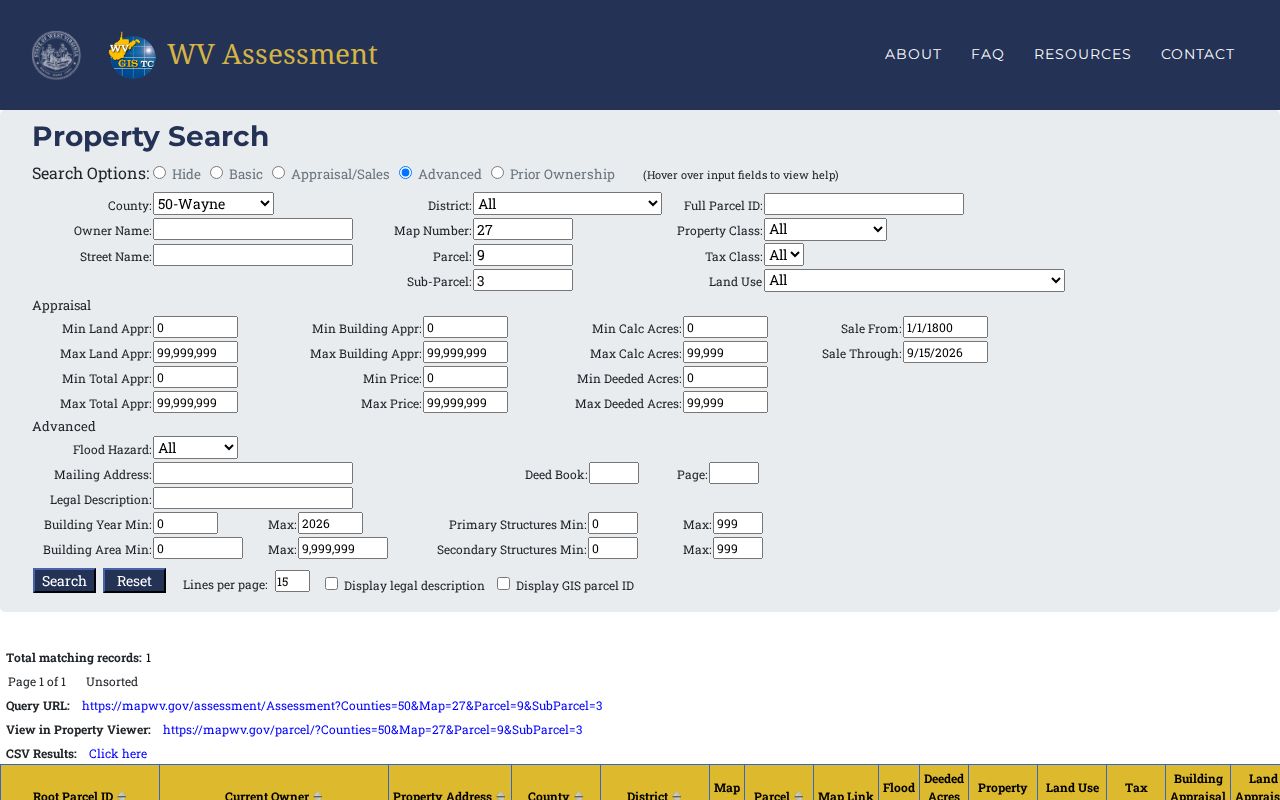
Use the sample to learn the columns, then confirm the real property with its parcel number and deed.
Sources for a Wayne County Owner Name
No single office holds all of ownership. The assessor's annual file names the current owner for tax purposes. The County Clerk records the deeds. A map viewer ties the parcel ID to a location. The Sheriff's account shows who receives the bill. A Wayne County owner lookup works best when these sources are compared. Trusting one at a time is a mistake.
| Source | Owner Info It Gives | Access |
|---|---|---|
| MapWV Assessment | Current Owner, parcel, address, acreage, appraisal | Annual data; simple recent changes can lag |
| Wayne County Clerk | Recorded deed parties and land description | At recording; index start year not located |
| WV Secretary of State | Entity name, filings, and possible registered address | Organization-name and document search |
| WV Property Viewer | Map location, parcel ID, owner, detail link | Free viewer; geometry may lag |
| Sheriff Tax Bureau | Bill recipient, account, year, and payment headings | WEBTax plus office or mail assistance |
An owner of record is the name in a public land or tax record. It does not confirm who occupies the building. Mailing address and situs are separate facts. A recent sale changes the picture. The County Clerk's recorded deed is then the best next check on the assessor field. See the Wayne County current-owner record explanation for present-tense roll detail.
Wayne County Recent Sale Timing
West Virginia runs its assessment year from July 1. Wayne County's Sheriff Tax Bureau freezes the name, value, and mailing-address file on that date for the coming tax year. A deed recorded after the freeze can leave the prior owner on the next tax bill. MapWV's statewide FAQ makes the same point. A simple ownership change may not have reached the viewer yet.
For a recent closing, trace the County Clerk's deed records first. The assessor still helps with the tax parcel and the label on the current roll. A just-recorded deed is often the fresher record of who owns the parcel. Ask the Sheriff's office to break a bill down by tax year and ticket. Treat the name printed on it as one clue, not the only one. The Wayne Sheriff's tax-cycle note explains why bill names can lag behind a transfer.
When sources disagree, note the date and role of each one before settling on a name. The Clerk's deed index is the place to verify a transfer recorded after the assessment file was set. The assessor remains useful for locating the parcel and seeing which owner the annual roll lists. The deed may cover multiple tracts. It may also cover only a partial interest. Compare the full legal description before assuming one name owns every nearby lot.
Owner-name matching has ordinary limits. Common surnames, initials, trusts, estate fiduciaries, and business abbreviations can all yield several plausible records. Narrow the field with the property's district and parcel number. Then read the underlying instrument instead of stopping at a list row. An owner-of-record field is a public-record label. It does not confirm who lives there, manages the property, or should be contacted. When you need official verification, use the custodian's process.
Wayne County LLC, Trust, and Estate Owners
Not every Wayne County parcel names a living owner. Some deeds list an LLC, a trustee, or an estate's executor. Start with the assessor's owner wording on the parcel record. A company may appear there. Turn to the West Virginia Secretary of State Organization Name and Document Search. That filing can surface the entity behind the name and a registered-agent address. It still cannot prove who controls the property. It never changes the land record itself.
A transfer with no ordinary sale often traces back to probate. The Wayne County Clerk posts small-estate, ancillary-administration, estate-appraisement, and fiduciary forms. The probate office works by appointment. Pull the recorded deed or affidavit that ties the estate to the parcel number. A will or business filing may explain a name. The land instrument remains the real evidence of transfer. A deed or assessor entry may carry a company name. WV Secretary of State organization search can then resolve it.
Wayne County Mailing and Situs Addresses
Situs and mailing address answer different questions. Situs is where the parcel physically sits. The mailing address is where the tax bill goes. MapWV opens with the physical address, and the parcel detail can list the owner's address separately. An absentee owner, an estate, a bank, or a company may route mail to a destination far from the parcel. A mailing address is a contact clue, never proof of residence.
Wayne County geography can also mislead a property search. Huntington straddles the Cabell and Wayne county line. Kenova sits at the Ohio and Big Sandy confluence, and the county seat lies inland on Twelvepole Creek. When a town or ZIP label seems off, confirm the county code, district, and map-parcel before trusting that the owner record belongs to the right place.
Wayne County Owner Record Alerts
Wayne County offers no official property-fraud alert signup. The clerk's portal does not send warnings. An owner who wants alert coverage should contact the County Clerk. Ask whether any program exists. Ask what it covers, too.
Meanwhile, keep your own paper trail. Save a copy of the deed. Save the parcel ID and the contact details for the office that recorded it. If a suspicious deed-copy mailer, tax demand, or title notice arrives, compare the listed phone and address against the official Clerk or Sheriff page before responding. The county's public record trail is still the way to verify an instrument. An alert, if one is ever offered, would only add notice on top.
Limits of a Wayne County Owner Lookup
A Wayne County lookup names the owner of record. It does not name everyone living at the address or holding an unrecorded interest. The property viewer is informational only. It is not a title search, an appraisal, a survey, or a zoning decision. State systems also protect or redact certain personal details. These include alarm-system information and sensitive court data. Public land ownership is never a reason to expose a protected address or contact someone in a threatening way.
Lawful use. Use a Wayne County owner search for property due diligence, house history, and civic research. Do not use a name or address to stalk, target, intimidate, or harass a person.